
Knight Vs Longhouse
Sir Gareth of Orkney's Great Quest

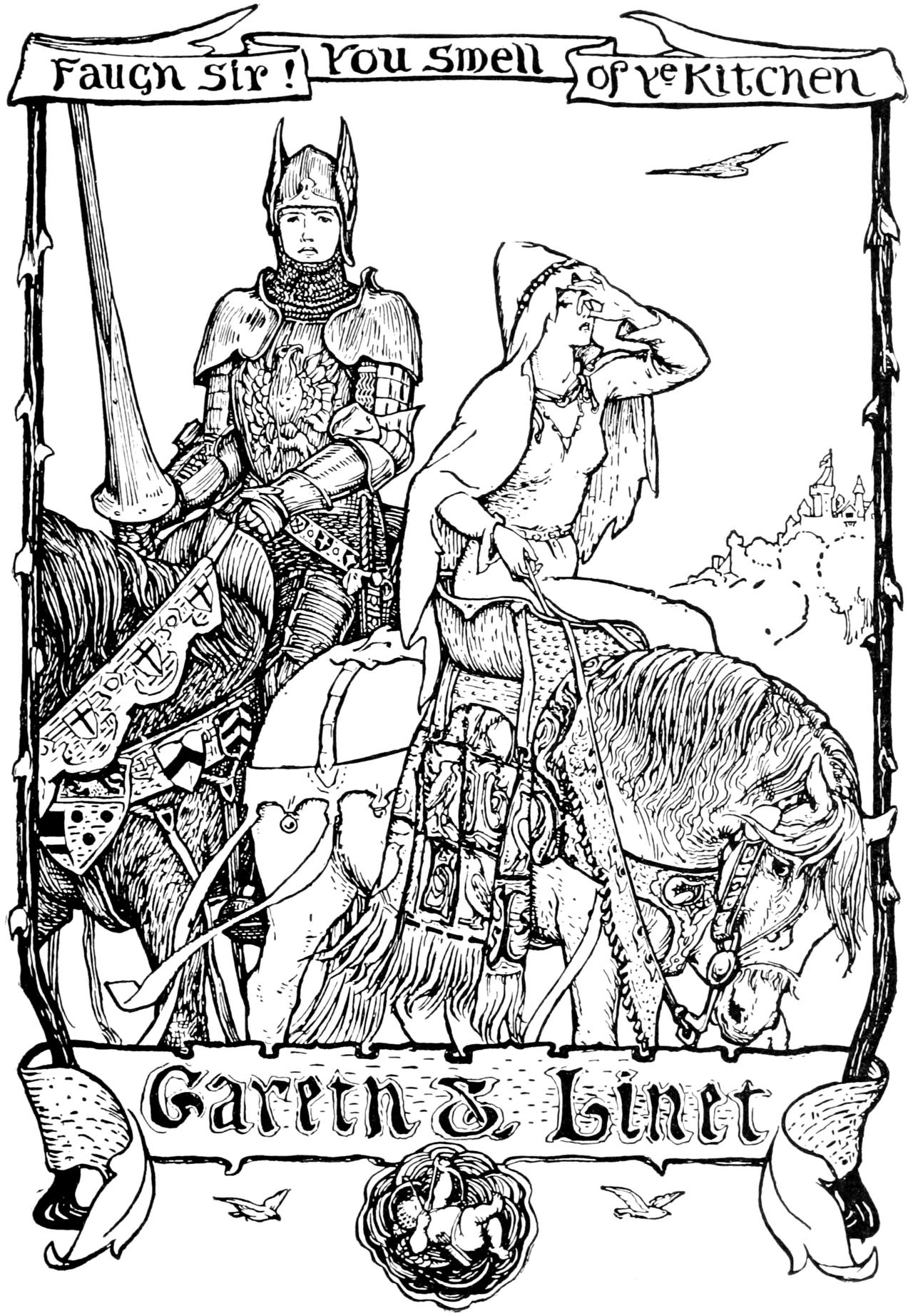
Those who have been trained to think of chivalry as basically synonymous with simping and “white-knighting”—and thus with the larger gynocentric drift of our times—will be surprised to learn that real chivalric literature actually warns about such things, rather than championing them. One of the best examples is the retelling by Alfred Lord Tennyson of the quest of Sir Gareth of Orkney in Idylls of the King. Published in 1872, this Arthurian romance hits surprisingly close to home for the young man of the 2020s—because Gareth is up against something like the Longhouse.
At the beginning “Gareth and Lynette,” the decline of Gareth’s aged father has left the young man under the dominion of an overbearing mother. When he reaches his hand to climb, literally or figuratively, his mother jumps in: “Climb not lest thou break thy neck,” she warns. Instead of his neck it’s Gareth’s heart that breaks—such are the consequences of safetyist dictates under matriarchal rule.
Rather than allow him to leave for Camelot to pursue his dream of becoming one of Arthur’s knights like his older brothers Gawain and Modred, Gareth’s mother lovingly demands that he stay and enjoy a life of ease and comfort under her supervision. She will find him a “comfortable” wife, and he can “follow the deer” until his heart is sated with hunting and other diversion.
But Gareth has real aspirations and will not be deterred. “Follow the deer?” he asks. No way—his calling is to “follow the Christ, the King, / Live pure, speak true, right wrong, follow the King— / Else, wherefore born?” He presses the issue again and again. In a final attempt to dissuade him, Gareth’s mother offers a bargain: he can go to Camelot if he agrees to labor anonymously in the kitchens for a year before joining Arthur’s Round Table. She’s sure this lowly obstacle will thwart the desires of a highborn young man, but to her horror Gareth agrees without hesitation.
Another aspect of the Longhouse—another impediment to Gareth’s aspirations—is a more subtle campaign of discouragement. Rumors swirl from all quarters about Arthur’s birth and legitimacy. Is he actually Uther Pendragon’s son? Is he really the king? Is an uncertain king worth serving? Others speculate that Camelot isn’t even a real place, just a vision conjured by a sorcerer. This debunking seems designed to crush a young man like Gareth with doubt and prompt him to ride back home to the comfort of his mother’s domain. But Gareth is made of sterner stuff.
After being made a knight, Gareth’s most aggressive challenge comes with the arrival at Camelot of a young lady seeking help. Lynette’s sister has been taken by four wicked brothers and held captive, so she needs a knight to fight for her and Gareth insists on being sent. Little does he know he’s entering a world not just of danger and combat, but of feminine “shit-tests”—struggles against the brothers and against the lady he’s trying to help! Lynette repeatedly lashes out at Gareth, calling him a “kitchen knave,” assuring him of his impending defeat against superior fighters, even demanding that he ride downwind of her so that she doesn’t have to smell the supposed kitchen grease on him.
To be fair, Lynette’s real complaint is more against King Arthur than Gareth. Her sister is in grave trouble and needs a proven hero, not a young man who until very recently had been serving in Arthur’s kitchen. Either way, Gareth is on the receiving end of the lady’s scorn. (Also: Arthur is not actually so negligent or callous, but secretly sends Sir Lancelot to watch out for the young knight.)
The quest before Gareth will require prowess and courage for struggle against the four brothers, as well as self-restraint for struggle against Lynette. He must duel her by mastering the rage she provokes in him—not because gentlemanly courtesy demands he volunteer himself for unlimited abuse, but because the mission requires it. To lash out against her is to waste energy and take his attention off the enemies in front of him, which would mean losing his chance to prove himself worthy of the Round Table. In today’s terms, he must maintain frame. And when she lashes out, Gareth doesn’t merely accept the insults like some pushover or some detached zen instructor, nor does he pretend to “not give a f---” what the lady says. Instead he channels the anger and uses it to against the bad men who stand in his way.
In one particularly charming episode of the quest, after the first of the brothers falls and now begs for his own life, Gareth turns the test on Lynette. He tells the knight his life will be spared only if the lady requests it—to which Lynette vows that she would never stoop to ask anything of a kitchen-knave like Gareth.
“Then he shall die,” Gareth says, and moves to kill him. Lynette predictably shrieks in horror and condescends to ask him to spare the man’s life (while also trying to save face and pretend as though Gareth hadn’t just gotten the better of her). Gareth must have smiled and they moved along to the next challenge.
Ultimately Gareth triumphs over Lynette’s enemies and over Lynette herself. After seeing his manhood on display again and again, she comes to understand the truth about her “kitchen knave.” Lynette’s apology culminates in one of the great lines of the entire Arthurian saga:
Shamed am I that I so rebuked, reviled,
Missaid thee; noble I am; and thought the King
Scorned me and mine; and now thy pardon, friend,
For thou hast ever answered courteously,
And wholly bold thou art, and meek withal
As any of Arthur’s best, but, being knave,
Hast mazed my wit: I marvel what thou art.
It’s the highest praise and it’s well-earned. He wins her over by being truly excellent, truly knightly, a marvel made to do good in a dangerous world.
And one part of his own marvelousness is maintaining his own good nature in spite of her taunts and scorn. He teases her rather than letting her games and tests get to him. He achieves his quest and wins her over by maintaining frame:
Good sooth! I hold
He scarce is knight, yea but half-man, nor meet
To fight for gentle damsel, he, who lets
His heart be stirred with any foolish heat
At any gentle damsel’s waywardness.
Sir Gareth and Us
Life in the Longhouse world is increasingly dark for our young guys—from dwindling economic prospects to dwindling romantic prospects, and everything in between. The point seems to be the crushing of a young man’s spirit. Large scale reforms will be required to address these civilization-threatening problems. But at the same time, Gareth’s quest suggests that there’s no substitute for aspiration and awesomeness. If you’re Sir Gareth of Orkney, they let you do it (eventually).
We might not be quite as good as he is, but we owe it to ourselves to see how good we can become. It might also be the case that unreasonable ladies like Lynette become more reasonable when they are won over, when they are made to marvel at what you are.
Related:


Also my book…
Amazing, I love it. I haven't read Tennyson, but I love this little bit of the story.