
Between Heroics and Human Resources
Thoughts on Masters of the Universe

Note: Please forgive my absence from the newsletter. I had some troubles to deal with. Beware of ticks—those devils aren’t messing around! But I’m feeling quite well now and will get the operation up and running again.
This weekend I decided to suspend my soft ban on popcult for a couple hours and made an outing to the multiplex for the new adaptation of Masters of the Universe, directed by Travis Knight and starring Nicholas Galitzine as Prince Adam. For better or worse, this was the dominant mythology of my childhood.1 The old cartoon, the action figures, and even the much-mocked Dolph Lundgren movie (which I unironically love) made a lasting claim on me during those crucial formal years.
The TL;DR is that Masters of the Universe is a high-energy and surprisingly well-made popcorn film. The trailers don’t do it justice (and whoever made them should be have to go back to trailer-making school). Knight’s movie has more heart than just about anything on offer today, and the screenwriters clearly tried to honor the source material rather than “subvert expectations.” It made me feel something.
But it was also a slightly dizzying experience. Masters has a particularly fascinating flaw. Which is: it actually flirts with being more than just a fun popcorn movie.
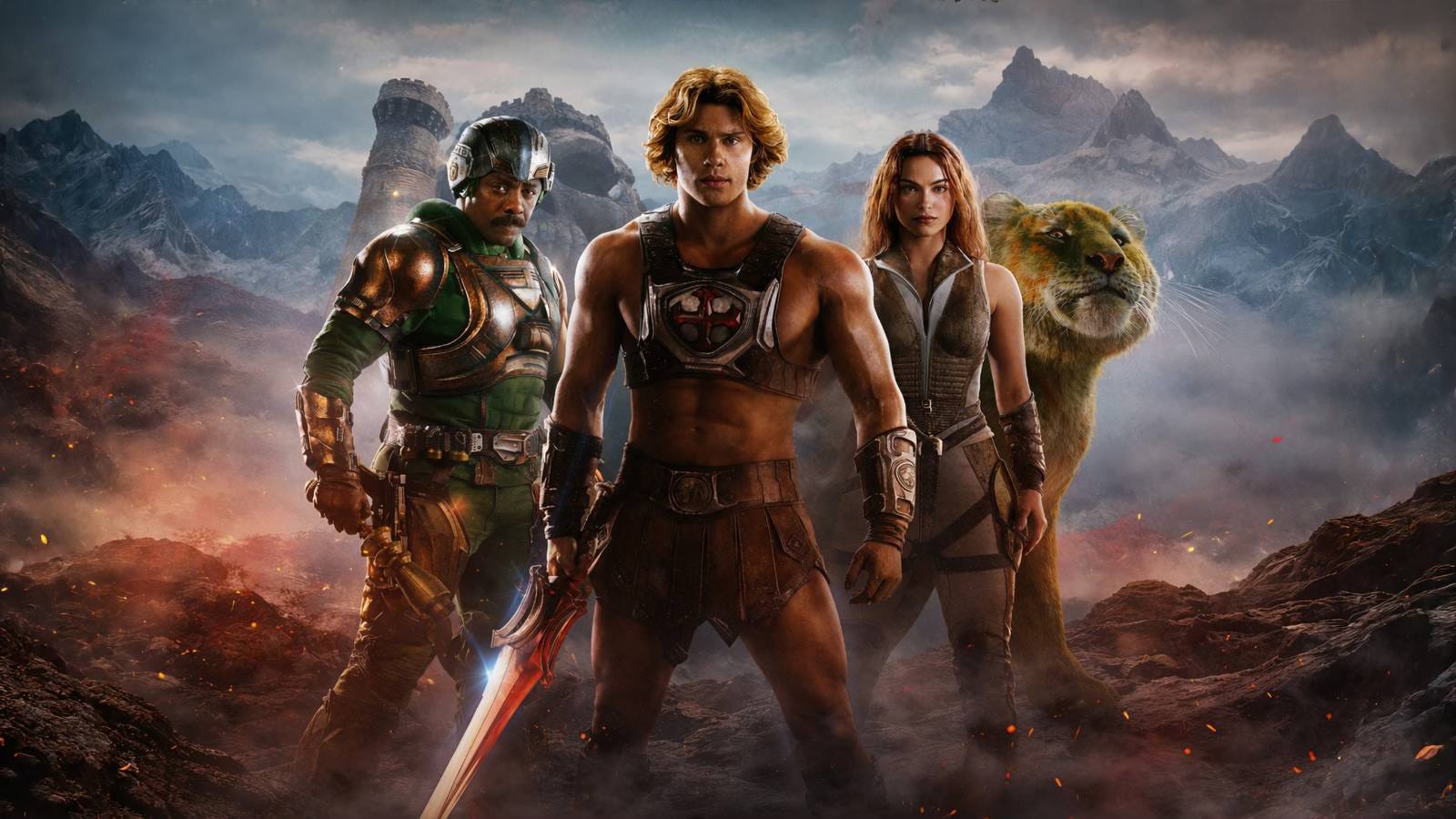
After his world is conquered by the forces of darkness in the opening scenes, ten-year-old Prince Adam of Eternia is sent to safety on the other side of the universe. Much like the 1987 version, this film brings us to earth.2 Fast-forward a little and Adam, now a full grown man of about twenty-five years, has become a corporate functionary in Oklahoma City.
Having entered the movie theater with very modest hopes, I was taken aback by how sneakily promising the first act is. We are immersed in the difficulties of a sensitive young man who—METAPHOR ALERT!—knows there’s more than the fake-and-gheyness offered by our times, particularly the spiritual destitution of life at the megacorp, where he’s hectored by a sloganeering HR lady-boss of color. He’s not where he belongs, and he’s not who he should be. His only mistake is telling too many people the truth about himself. They think he’s crazy. An attractive young lady walks out on Adam during a date as he tries to explain. A friend asks why Adam can’t just give up that stuff and be “normal”—which means suffering through the grind of work, living for the weekend, and counting down the days until your next vacation, like everyone else. We even hear that Adam has even been hoodwinked into going to therapy and is told he has turned the traumatic loss of his parents into a convoluted narrative about Skeletor, talking tigers, magic swords, and a planet called Eternia.
He’s not having it, though. He knows who he is. They think they’re the ones living in reality, but it’s their lives that are fake.
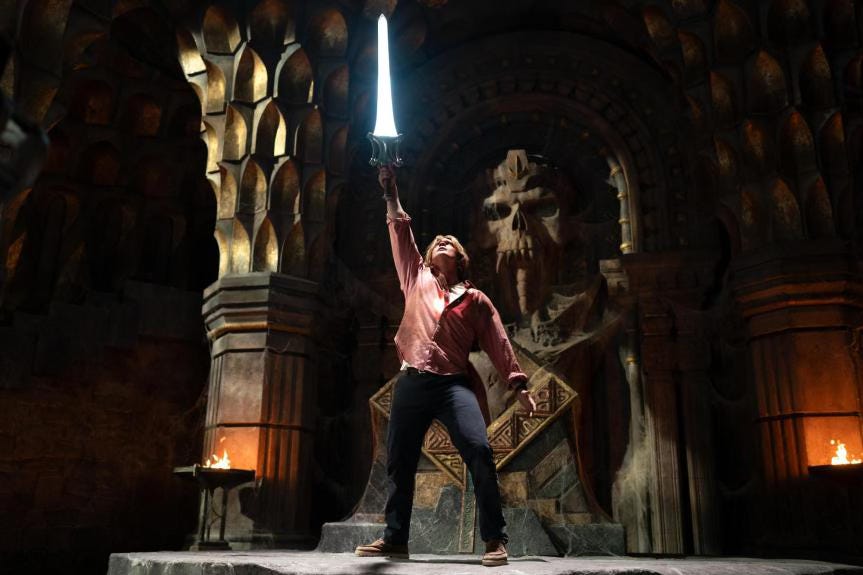
The one thing Adam has—his one reason to carry on—is the search for the magical sword he lost while crash-landing on earth years ago. The sword, he was told, is his way back home. So he puts out inquiries on online message boards and chats: “Have you seen this sword?” Finally, thanks to a tip from a local weirdo, Adam gets his hands on it—only to be arrested shortly afterwards by a bumbling and obese lady cop.
The lady cop was the clinching detail. At this point, I was convinced that the writers all had impossibly based anon rw Twitter accounts and that I was in for a masterpiece about a young man’s quest to reclaim “the Power” which has been systematically robbed from him.

But I was wasn’t quite right. Fun as the rest of the film proves to be, Prince Adam puzzlingly returns to much of his previous HR training as he becomes He-Man and battles to save Eternia. He tries team-building exercises with his new allies. He attempts conflict resolution with his enemies. He pop-psychologizes about why Skeletor is the way he is. Perhaps this is just what happens when you try to out-Marvel the MCU. Either way, the movie proves a little confused about its own stance on the first act.
To the filmmakers’ credit, the conflict resolution stuff doesn’t really work, and after it fails Adam acknowledges “the time for talk is over.” Which means it’s time to fight. There’s also something narratively thrifty, to be fair, about a story which attempts to make use of a character’s past. We’re left with a few problems, though. One is that Adam’s previous life apparently wasn’t as awful as we’d been led to believe. Listening to his diversity boss’ slogans couldn’t have been that bad if he’s now using them himself. The second is that He-Man’s heroic style—strength plus gentleness—is informed not by chivalry (of a sci-fi/fantasy sort) but by HR platitudes. A card in the closing credits informs us that “villains monologue, good guys dialogue.”
(One might hear the argument that HR He-Man is aligned with the hokeyness of the 1983 cartoon; it’s the filmmakers’ attempt to capture the spirit. If that’s true, then this is an instance in which adherence comes at the expense of narrative possibility. I’m all for honoring the source material, but ultimately the best way to do that is by offering the best movie possible. There are other ways to make He-Man charmingly hokey and partially autistic, in keeping with the cartoon.)
To state an abundantly obvious point—so obvious that it probably shouldn’t even be mentioned—the Cult of HR chokes out the heroic. It strangles life, energy, charm, idiosyncrasy, aspiration, risk-taking. In short, it strangles manliness—replacing it with universal governess-tyranny and then fixating on a phantom boogeyman called “toxic masculinity.” For those not paying attention to such things, Travis Knight had fans very very worried with his comments about toxic masculinity being one of the movie’s concerns. Thankfully the references were oblique enough to avoid derailing the film, though they might make the observant viewer wince just a little. But this explains why they felt the need to offer HR masculinity as the counter to toxic masculinity. Again, there are other and better possibilities here.
The fault’s mine for thinking that Masters ever could have been what it was hinting at. No such thing can come from the giant popcult corporations—like Amazon MGM Studios—which have been commandeered by the spirit of HR as a condition for their monstrous scale. Only a silly person would expect truly manly and heroic movies from enemy-occupied organizations. Masters of the Universe comes enjoyably close, though, all things considered.
Related:


Also my book…
Looking back, I’m mostly appalled by my formation at the hands of the popcult. But in this case it really could have been worse. He-Man is not so terrible a hero for a boy to have.
People tend to bemoan this. They want the entire thing to be set on Eternia. But I am all for it.
This was my formative mythology as well, and I was feeling skeptical about the movie, but considering giving it a chance, until a spoiler was dropped on me just before release that torpedoed my interest.
He-Man accidentally causes the death of King Randor? And, as people who've seen the movie have confirmed, that's just a 'mark it off the plot checkpoint list and move on' point, probably left over from an earlier script draft?
When two of the defining features of Filmation He-Man are his respect for all life--to the point that he renounced the Power of Grayskull when tricked into believing that he'd caused the accidental death of an innocent bystander--and his desire for his father's approval, you can't claim to be a lighthearted romp doing homage to the 80s cartoon and then drop something like that without paying any attention to it.