
The Unnecessary War (That Changed the Course of Human History and Killed the West)
A Review of Buchanan's Churchill, Hitler, and the Unnecessary War

I remember several years ago feeling a little dirty after watching a movie about an elite vampire lady-soldier (played by Kate Beckinsale) who learns that everything she’s been taught was a lie, especially regarding her kind’s long-raging war against werewolves. The vampire lady-soldier was shaken to the core. Her whole life had been in service of that lie. Now who was she? Even if the whole thing was silly and edgelordy—the premise had probably been spitballed by some left-libertarians between bong hits—I was strangely revulsed at the thought of living in a world in which you couldn’t trust the general narratives about what’s what.
Fast-forward to the 2020s—and the Pandemic forced similar discovery arcs on many. Just like Kate, I was rattled to learn the truth about a larger pattern of fibs, falsifications, and pretty lies we were told all our lives, not about werewolves but about everything from food and health to politics and history.
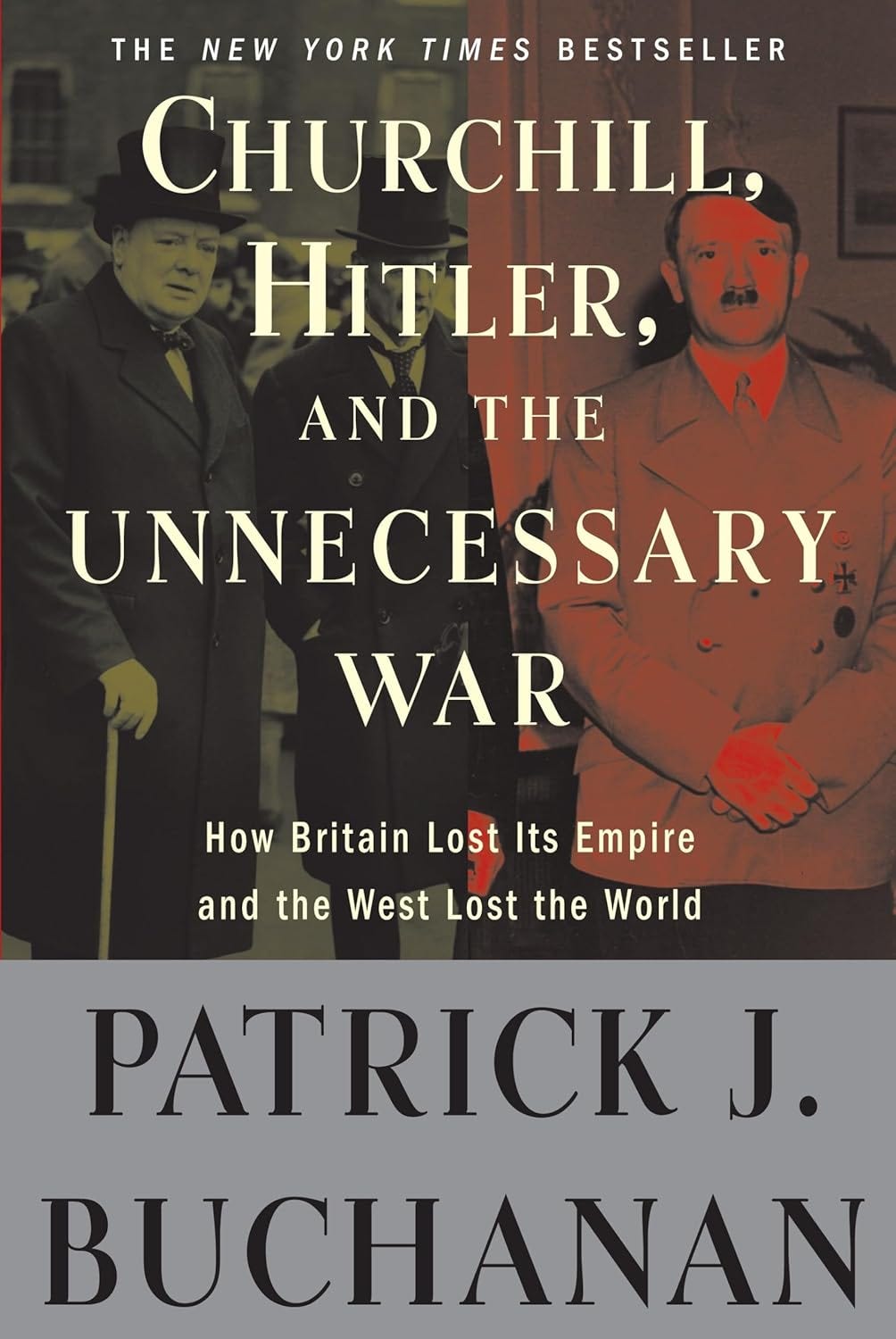
Which brings me to Patrick J Buchanan’s Churchill, Hitler, and the Unnecessary War, a book that accelerated the process for me. Written in 2008, The Unnecessary War takes aim at the founding event of the postwar order: World War II, in which the armies of democracy supposedly saved the world from the forces of fascism.
It should be noted that the author was not the Scott Horton or Candace Owens of his time, not some fringe figure easily dismissed as a contrarian or revisionist. Buchanan worked in the Nixon and Reagan administrations during the ‘60s, ‘70s, and ‘80s, and he could be seen on national television multiple times each week during the ‘90s (The McLaughlin Group, Crossfire, The Capital Gang). His newspaper columns were nationally syndicated.
But he eventually fell out of favor with fashionable society and the controlled opposition they allowed in their company. Conservative gate-keeper William F Buckley accused him of antisemitic comments, and Charles Krauthammer threw around the word “fascistic.” Buchanan upset the cheerleaders and backers of Wars for Democracy, GDP-worship, and endless immigration. Looking back now, his real offense was being wayyy ahead of his time, and only recently has the critical mass started catching up.
World War II is known as the “good war.” But you can’t talk about Part II (the good one) without Part I (the ugly and probably pointless one), and the good one starts to look at lot uglier on closer inspection. The author argues that these two wars ought to be renamed “the Great Civil War of the West,” a more suitable title for an unforced civilizational suicide, and he invites you to pull up a chair for a slow-motion replay of the death of our way of life.
It’s very difficult to walk away from this book with warm feelings for Winston Churchill—the great man who supposedly saved all freedom-loving people from living under a 1000-year reign of global National Socialist tyranny. The author states in the introduction his desire to put an end to this myth.
In 1914, Churchill was one of the leading agitators for Britain’s involvement in the conflict between Germany/allies and France/allies, though most of his country’s government was skeptical. “And it was Britain,” Buchanan writes, “that turned both European wars into world wars.” Churchill’s contemporaries had alarming things to say about his conduct during this time, but the case built against the man is damning enough using just his own words:
“Everything tends toward catastrophe and collapse. I am interested, geared up and happy. Is it not horrible to be built like that?”
“I know this war is smashing and shattering the lives of thousands every moment and yet—I cannot help it—I enjoy every second.”
“This, this is living History. Everything we are doing and saying is thrilling—it will be read by a thousand generations, think of that! Why I would not be out of this glorious delicious war for anything the world could give me.”
Having done his part to get Britain involved, he proceeded to make the war far worse once it was underway. As First Lord of the Admiralty, Churchill was the “architect and chief advocate” of the starvation blockade of Germany, the aim of which was to “starve the whole population—men, women, and children, old and young, wounded and sound—into submission.” Those are his own words. Worse, the attempt to starve a whole population continued long after the Germans laid down their arms. “On March 3, 1919, four months after Germany accepted an armistice and laid down her arms, Churchill rose exultant in the Commons to declare, ‘We are enforcing the blockade with rigor, and Germany is very near starvation.’” To repeat: he spoke this four months after fighting had stopped!
Not until July 12, 1919—two weeks after the Germans had signed the Treaty of Versailles—was the blockade finally lifted. Estimates of the death toll range from 400,000 to 760,000 Germans.
It was under these conditions that Germany was strong-armed into signing the devastating Treaty of Versailles: stripping the country of huge chunks of people and territory, internationalizing its rivers, ordering $32B to be paid in reparations, and demanding acknowledgment of guilt for the war. Sign all of these or else your people will continue to starve to death! “Germany,” Buchanan writes, “was to remain forever naked to her enemies.”
In retrospect, it seems beyond-obvious that one of the most dynamic peoples in the history of the world wasn’t just going to let this punitive humiliation stand. Even the English economist John Maynard Keynes thought his country had gone too far, calling the reparations “one of the most serious acts of political unwisdom for which our statesmen have ever been responsible.”
A Few Years Later…
In building his case against Churchill, Buchanan shows no love for Hitler or the National Socialists. He employs the obligatory adjectives—heinous, barbaric, etc—at every opportunity and accuses them of numerous evils toward the “chosen people” and others. But he also rejects the vague “And Then One Day, For No Reason At All…” narrative that obscures who the Nazis were and why they did what they did.
Buchanan argues that Hitler had no designs on world domination (contrary to the premise of certain shows on Prime Video). He neither thought it possible nor good. Hitler actually admired the British Empire, wanted it to survive, and dreamed of an alliance between his country and their British cousins. (Which is why he allowed the escape at Dunkirk.) What Hitler did want was to build a Versailles-proof Reich, which required reclaiming the lands and peoples they had lost in the treaty as well as expanding to the east. No more starvation blockades.
The author catalogs Hitler’s coups in pursuit of this vision: the rebuilding of the fleet, alliances with Italy and Japan, the Munich Agreement, and so on. His narrative hits its crisis in Poland in 1939, when Germany reached out to the Poles with a surprising offer: “If Warsaw would permit the ‘reunion of Danzig with the Reich’ and consent to Germany’s building of ‘an extra-territorial motor road and railway line’ across the Corridor, Berlin would leave Warsaw in control of the economic and railway facilities in Danzig and guarantee Poland’s frontiers.” Danzig was 95% German and was eager to return to the mother country. “Of all the German claims to lost lands,” Buchanan writes, “the claim to Danzig was strongest.” The Germans had even hoped that this would mean a “Berlin-Warsaw alliance against Russia.”
Though Poland was in an unenviable position—stuck in a no-man’s land between the world’s most dangerous powers—the choice should have been fairly easy. Most eastern European countries knew well enough to be scared of the Germans, but far more scared of the Soviets. One Polish marshal commented, “With the Germans we risk losing our liberty; with the Russians we lose our soul.” At this point Hitler had not yet taken on his final form of Pure Evil; his “body count” was still only in the hundreds, while Stalin’s was in the millions—1000x that of Hitler’s.
But the Poles saw it differently. “Now they had to choose between Russia and Germany,” writes historian AJP Taylor. “They choose neither.”
The reason the Poles felt confident choosing NEITHER was because Britain gave “an unconditional guarantee of [their] independence in the event of an attack by Germany.” The British had determined they could not allow Hitler to pull off another bloodless coup, so they issued a promise they could not keep, in a part of Europe that was of little interest to them. And then the war came.
Consequences
What followed was a catastrophe unlike anything the world has ever seen, dwarfing even the first episode of the Great Civil War of the West. Millions and millions of the finest young men of Europe slain—again. The most bitter irony is, of course, that those same Poles whom the Brits had falsely vowed to defend against German encroachment would suffer several decades of Soviet domination, as did most of eastern Europe.
What were Britain’s alternatives to an unnecessary war with Germany? Buchanan suggests a tantalizingly straightforward one: just leave Hitler to fight Stalin! That’s what Hitler really wanted all along.
All of this played out very much to the liking of Joseph Stalin. We talk about the liberal democracies “winning” the Second World War, but that’s not what really happened. “War between Nazi Germany and Britain and France would weaken all three and fertilize the ground for Communist revolution in all three nations. Stalin’s relief and joy can only be imagined,” Buchanan writes. (Read Stalin’s War by Sean McMeekin for an even more nightmarish account of how badly this war turned out.)
Riding into office on the wave of the conflict he had been baying for, Prime Minister Churchill continued his highly questionable record from the previous war. He rejected peace overtures and began bombing non-combatants in Germany—a decision he mentioned to Stalin during their meeting in 1942, apparently in hopes of impressing him. The firebombing of Dresden in 1945 fits the larger pattern. Even if it doesn’t compare to the starvation blockade in terms of death toll, the savagery is on par—Allied bombs in such quantities that the heat melted the streets and burned the shoes of German citizens attempting to escape the inferno.
But the worst might be Churchill’s negotiations with the Soviets. Buchanan argues that the concessions he made to Stalin at Moscow were “far worse” than the infamous concessions made by his predecessor Neville Chamberlain to Hitler at Munich.
Churchill signed away 100,000,000 Christians to Stalin’s terror and agreed to let him annex the Baltic states and 40% of Poland, the nation for whose ‘integrity’ Britain had gone to war. At his wartime summits with Stalin, Churchill also agreed to the ethnic cleansing of thirteen to fifteen million Germans from their ancestral homes, two million of whom would die in the exodus. He agreed to Stalin’s use of Germans as slave laborers, and to the forced repatriation of millions of Russians, Ukrainians, and Cossacks to a barbaric Asiatic regime he had called the foulest murderers in all of history.
So what again was all that for? Under Churchill, Britain experienced its “finest hour”—but at the cost of millions of lives, as well as the British empire and way of life, and the future of West. In his maniacal drive to save the world from the Hitler’s regime, Churchill made allies with a more wicked and more ambitious man and conceded him far more territory than Hitler had been eyeing. As Churchill himself later wrote in The Gathering Storm, “we lie in the grip of even worse perils than those we have surmounted.” It all amounts to endless unnecessary warring and destruction so that Churchill could playact at heroics.
Buchanan’s book is an enraging horror-show. Proceed with caution and read only if you are not attached to the public school narratives about our past. But for those ready to face certain truths—ready for their Kate Beckinsale arc—it is an unforgettable book.
Related:


Also my book…
The reason he wrote that book is because there’s a cult like worship around Churchill with our political establishment.
In many ways they place him above Christ himself.
Buchanan turned out to be right in the end; trillions of dollars later, a destroyed Middle East, a migrant crisis throughout the west Buchanan truly turned out to be a John the Baptist figure in the political arena.
May he rest in eternity✝️
This is the narrative our guys and our side needs to keep pounding